
About Cannabis
Biochemistry of Cannabis
Let’s Delve Into The World of Cannabis
The human body possesses specific receptors, CB1 and CB2, designed to interact with cannabinoids. Remarkably, mammals, including humans, produce their own cannabinoids, known as endocannabinoids (like anandamide and 2-AG), to maintain a state of balance or homeostasis. These compounds act as the essential key that activates our natural receptors, enabling regulation of crucial aspects such as appetite, mood, pain perception, memory, and concentration.
The Endocannabinoid System (ECS)
The ECS is an active and complex cell interaction network composed of chemical neurotransmitters (the endocannabinoids) that bind to a large web of receptors (CB1 and CB2) distributed throughout the body, and then broken down by metabolic enzymes.
Currently, two types of cannabinoid receptors have been identified, the CB1 and CB2 receptors. They differ in the way they transmit signals and their distribution throughout the body.
Activation of cannabinoid receptors leads to inhibition of adenyl cyclase, which prevents the conversion of ATP to cyclic AMP (cAMP). Both CB1 and CB2 belong to the extensive family of G protein-coupled receptors.
CB1
Found in the brain, central nervous system, lungs, muscles, vascular system, gastrointestinal tract, and reproductive organs.
CB2
Found in spleen, bones and skin.
CB1 + CB2
Found in immune system, liver, bone marrow, and pancreas.
Chemistry of Cannabis
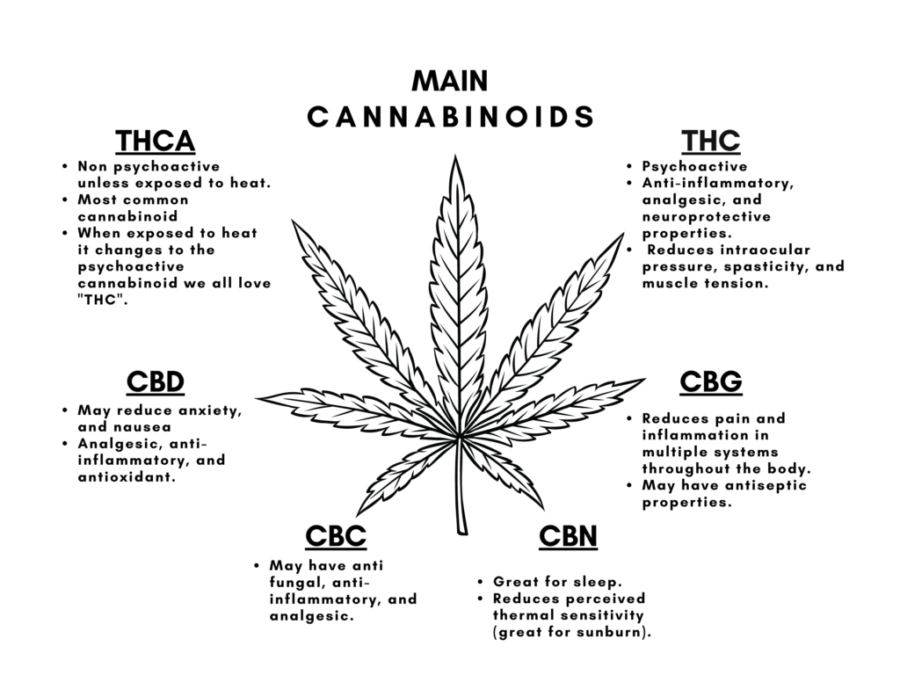
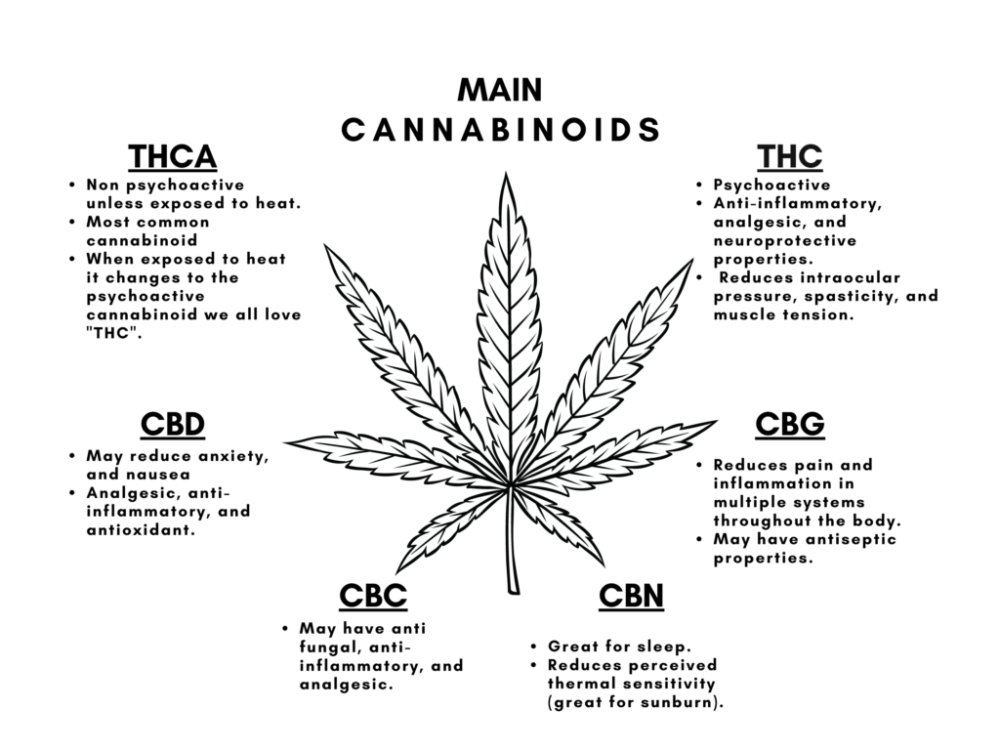
Cannabis contains more than 500 biochemical compounds. There are flavonoids, terpenes, phytocannabinoids, and proteins – all with potential therapeutic applications. Cannabidiol (CBD) is a non-psychoactive cannabinoid and Tetrahydrocannabinol (THC) is a psychoactive cannabinoid found in cannabis plant. Both have been proven to have multiple benefits.
Endocannabinoid systems are a complex and integral part of every mammal’s wellbeing. Cannabinoids are organic chemical compounds that work with other modulatory systems to interact with and activate certain receptors and regulate various systems in humans and other mammals such as appetite, mood, pain perception, memory and concentration.
Terpenes
Terpenes are organic chemical compounds we can find in almost any plant. They are responsible for the distinct flavor and smell of flowers and some fruits. There are even some animals that produce terpenes such as termites and some butterflies. They have important therapeutic uses and a fundamental role in promoting the “entourage effect” in conjunction with cannabinoids. Some terpenes help you relax, while others promote attention and alertness. Without terpenes, there would be no sativa, indica, or hybrid effects from the cannabis plant!
The cannabis plant contains more than 120 terpenes, but the most common ones are:
Myrcene – Which exhibits sedative, antioxidant, anti-inflammatory, analgesic effects, and increases cell permeability. Commonly found in Indica strains.
Limonene – Which increases serotonin levels in our body. It is also responsible for citrusy smell that is dominant in many Sativa strains.
Linalool – Which has powerful sedative and relaxing effects. It is commonly found in Indica strains.
Caryophyllene – Which has anti-inflammatory properties and strongly interacts with CB2 receptor, meaning it’s the only known terpene with similar effects to cannabinoids. This terpene is also the most common one found in extracts, because it survives extraction process unlike most mono terpenes.
What Is CBD?
CBD, short for cannabidiol, has garnered significant attention for its potential healing properties. Derived from the hemp plant, CBD is a non-psychoactive compound that interacts with the body’s endocannabinoid system (ECS). The ECS plays a crucial role in maintaining balance and promoting homeostasis in various bodily functions. CBD’s interaction with the ECS has been associated with a wide range of potential health benefits. Many users report finding relief from issues like chronic pain, anxiety, and insomnia. Additionally, studies suggest that CBD may have anti-inflammatory properties. As research continues to unfold, CBD’s healing potential continues to captivate the interest of both consumers and the medical community alike.
What Is THCA?
THCA stands for Tetrahydrocannabinolic Acid, which is a naturally occurring cannabinoid found in the cannabis plant. THCA is the precursor to THC (tetrahydrocannabinol), which is the psychoactive compound responsible for the “high” associated with marijuana use.
In its raw form, cannabis contains THCA instead of THC. When the cannabis plant is heated through a process called decarboxylation, THCA loses a carboxyl group and converts into THC. This conversion happens when cannabis is exposed to heat, such as during smoking, vaporization, or cooking.
What is Delta 9?
Delta-9 refers to delta-9-tetrahydrocannabinol, often abbreviated as THC. It is the primary psychoactive compound found in cannabis, responsible for the “high” or euphoric effects commonly associated with marijuana use. THC interacts with the endocannabinoid system in the human body, specifically binding to cannabinoid receptors in the brain and central nervous system.
What is CBG?
CBG stands for cannabigerol, which is often referred to as the “mother cannabinoid” because it is considered a precursor to other cannabinoids like THC and CBD. As the cannabis plant matures, CBG is converted into other cannabinoids through enzymatic processes. This means that CBG is usually found in lower concentrations in mature cannabis plants compared to THC and CBD.
CBG has been the subject of growing interest in the medical and research communities due to its potential therapeutic properties. CBG fights inflammation, pain, nausea.
What is CBN?
CBN stands for cannabinol. CBN is typically present in very low concentrations in fresh cannabis plants. It is actually a degradation product of THC, meaning that as THC undergoes oxidation and breaks down over time or due to exposure to light and air, it can convert into CBN. This is why aged or improperly stored cannabis products tend to have higher levels of CBN.
CBN is non-psychoactive, which means it does not produce the euphoric “high” associated with THC, but it does play a big role in promoting relaxation and sleep.
History of Cannabis
Ancient Cultures
Cannabis and humanity have had a close relationship since ancient times. There is evidence of its use since 10,000 BC in the Chinese culture, where its seeds were used as food, the leaves were used to cultivate the silkworm, from the fivers of the stem they made textiles, and thanks to the properties of the same they made bows like armament. The first record of the medicinal use of cannabis is attributed to the Emperor Shennong in the 28th century BC.
2000 BCE
Emperor Shen-Nung, the father of Chinese medicine, recognized the benefits of cannabis for over 100 aliments, according to the Pen-ts’ao Ching
1500 BCE
A wooden brazier was used to inhale cannabis smoke in China, likely as part of a burial ceremony.
800 BCE
The Atharva Veda, a collection of holy writings in Sanskrit, mentions cannabis’ medicinal and spiritual uses.
600 BCE
The ancient Scythians of Central Asia use the first hot box. or “vapor bath” and gold bongs.
100 CE
In the Greco-Roman world, many texts are published on the medical uses of cannabis
1000 CE
The Angelo Saxon Herbarium is one of the fist texts to document cannabis usage in Europe.
1025 CE
Persian scholar Avicenna acknowledges cannabis as a useful medicine.
1500s
Cannabis comes to the Americas via Spanish conquistadors and enslaved Africans
1611
King James I of England decrees that colonists of Jamestown, Virginia, grow hemp
1798
Hashish comes to France after Napoleon’s campaign in Egypt and spreads throughout Europe.
1830s
Irish doctor William O’Shaughnessy and French psychiatrist Jacques-Joseph Moreau publish on the medical uses of cannabis, influencing Western medicine.
1834
Britain abolishes slavery in its colonies, and Indian indentured servants are thought to bring ganja to the Caribbean.
History of Cannabis In The United States
1906
Pure Food and Drug Act
Required labeling of any cannabis contained in over-the-counter remedies.
1900-20s
Mexican Immigrants Introduce Recreational Use of Marijuana Leaf
After the Mexican Revolution of 1910, Mexican immigrants flooded into the U.S., introducing to American culture the recreational use of marijuana. The drug became associated with the immigrants, and the fear and prejudice about the Spanish-speaking newcomers became associated with marijuana. Anti-drug campaigners warned against the encroaching “Marijuana Menace,” and terrible crimes were attributed to marijuana and the Mexicans who used it.
1930s
Fear of Marijuana
During the Great Depression, massive unemployment increased public resentment and fear of Mexican immigrants, escalating public and governmental concern about the problem of marijuana. This instigated a flurry of research which linked the use of marijuana with violence, crime and other socially deviant behaviors, primarily committed by “racially inferior” or underclass communities. By 1931, 29 states had outlawed marijuana.
1930
Creation of The Federal Bureau of Narcotics (FBN)
Harry J. Anslinger was the first Commissioner of the FBN and remained in that post until 1962.
1932
“Reefer Madness”
Propaganda film “Reefer Madness” was produced by the French director, Louis Gasnier.
The Motion Pictures Association of America, composed of the major Hollywood studios, banned the showing of any narcotics in films.
1944
La Guardia Report Finds Marijuana Less Dangerous
New York Academy of Medicine issued an extensively researched report declaring that, contrary to earlier research and popular belief, use of marijuana did not induce violence, insanity or sex crimes, or lead to addiction or other drug use.
1940s
“Hemp for Victory”
During World War II, imports of hemp and other materials crucial for producing marine cordage, parachutes, and other military necessities became scarce. In response the U.S. Department of Agriculture launched its “Hemp for Victory” program, encouraging farmers to plant hemp by giving out seeds and granting draft deferments to those who would stay home and grow hemp. By 1943 American farmers registered in the program harvested 375,000 acres of hemp.
1951-56
Stricter Sentencing Laws
Enactment of federal laws (Boggs Act, 1952; Narcotics Control Act, 1956) which set mandatory sentences for drug-related offenses, including marijuana.
A first-offense marijuana possession carried a minimum sentence of 2-10 years with a fine of up to $20,000.
1960s
Marijuana Use Popular In Counterculture
A changing political and cultural climate was reflected in more lenient attitudes towards marijuana. Use of the drug became widespread in the white upper middle class. Reports commissioned by Presidents Kennedy and Johnson found that marijuana use did not induce violence nor lead to use of heavier drugs. Policy towards marijuana began to involve considerations of treatment as well as criminal penalties.
1968
Creation of the Bureau of Narcotics and Dangerous Drugs
This was a merger of FBN and the Bureau of Dangerous Drugs of the Food and Drug Administration.
1970
Repeal of most mandatory minimum sentences
Congress repealed most of the mandatory penalties for drug-related offenses. It was widely acknowledged that the mandatory minimum sentences of the 1950s had done nothing to eliminate the drug culture that embraced marijuana use throughout the 60s, and that the minimum sentences imposed were often unduly harsh.
Marijuana differentiated from other drugs
The Comprehensive Drug Abuse Prevention and Control Act categorized marijuana separately from other narcotics and eliminated mandatory federal sentences for possession of small amounts.
National Organization for the Reform of Marijuana Laws (NORML) founded
1972
Shafer Commission
The bipartisan Shafer Commission, appointed by President Nixon at the direction of Congress, considered laws regarding marijuana and determined that personal use of marijuana should be decriminalized. Nixon rejected the recommendation, but over the course of the 1970s, eleven states decriminalized marijuana and most others reduced their penalties.
1973
Creation of the U S Drug Enforcement Agency (DEA)
Merger of the Bureau of Narcotics and Dangerous Drugs (BNND) and the Office of Drug Abuse Law Enforcement (ODALE).
1974
“High Times Founded”!
1976
Beginning of parents’ movement against marijuana
A nationwide movement emerged of conservative parents’ groups lobbying for stricter regulation of marijuana and the prevention of drug use by teenagers. Some of these groups became quite powerful and, with the support of the DEA and the National Institute on Drug Abuse (NIDA), were instrumental in affecting public attitudes which led to the 1980s War on Drugs.
1986
Anti-Drug Abuse Act – Mandatory Sentences
President Reagan signed the Anti-Drug Abuse Act, instituting mandatory sentences for drug-related crimes. In conjunction with the Comprehensive Crime Control Act of 1984, the new law raised federal penalties for marijuana possession and dealing, basing the penalties on the amount of the drug involved. Possession of 100 marijuana plants received the same penalty as possession of 100 grams of heroin. A later amendment to the Anti-Drug Abuse Act established a “three strikes and you’re out” policy, requiring life sentences for repeat drug offenders, and providing for the death penalty for “drug kingpins.”
1989
Bush’s War On Drugs
President George Bush declares a new War on Drugs in a nationally televised speech.
1996
Medical Use Legalized in California
California voters passed Proposition 215 allowing for the sale and medical use of marijuana for patients with AIDS, cancer, and other serious and painful diseases. This law stands in tension with federal laws prohibiting possession of marijuana.
Information gathered from https://www.pbs.org/wgbh/pages/frontline/shows/dope/etc/cron.html
For more information about the history of cannabis please click on the link below.